Showing posts with label 2013. Show all posts

Friday, January 16, 2015

Peugeot RCZ Coupe, 2013

Peugeot RCZ Coupe, 2013, Autos, Luxury Automobiles, Automotive, Car ConceptPeugeot RCZ Coupe, 2013, Autos, Luxury Automobiles, Automotive, Car Concept
 Peugeot RCZ Coupe, 2013, Autos, Luxury Automobiles, Automotive, Car ConceptPeugeot RCZ Coupe, 2013, Autos, Luxury Automobiles, Automotive, Car Concept
  

The Peugeot is increasing the appeal and exclusivity of its popular RCZ Sports Coupé. Sensuous and sleek, sporty and elegant, its new style promotes its power and fluidity, strength and refinement, and affirms its distinctive singularity in the Peugeot range.

Its richness of expression is greatly increased by an extended range of colour and material combinations, both to exterior and interior, which will allow each customer to construct 'their own' Peugeot RCZ. This increase in emotional power will continue in 2013 with the introduction of a powerful 1.6-litre THP 260bhp version with enhanced performance.

The Peugeot RCZ fully embodies the new signature of Peugeot: MOTION & EMOTION. It is the most visible expression of the Marque's expertise:

  •     Expertise with its 'Design Style' - with a very strong design
  •     Expertise in producing 'High Quality' products with exclusive positioning
  •     Expertise with strong 'Dynamic' standards to combined ride and handling.


The Peugeot RCZ has already created a desirable following with strong sales, excellent press coverage, and achievements in competition. It has won numerous awards from the public and the specialist press, in various countries, for its design, desirability and performance.

Adapted for competition from 2010 with a 200bhp HDi FAP diesel engine, it has twice won the D1T category (1700 to 2000cc diesel) at the 24 Hours Nürburgring.

Increase in emotional power
In this very specific market segment of sports coupés, the 'enthusiasts' of attractive cars with a distinctive style identity, dynamic capability and sportiness, are also aware of innovation.

They are looking for the latest, most attractive creation around a radical coupé, so it is necessary to renew and improve, responding to the constantly moving trend of this market. Strengthened by its success, less than three years after its commercial launch, the emblematic sports coupé of the Peugeot marque is adopting a new distinctive identity to embody more than ever the range enhancement and to embrace the MOTION & EMOTION signature of Peugeot.

Exterior personalisation
The new RCZ has many personalisation components:

  • A new lacquered black grille bars option, instead of the standard satin chrome bars, to give this new Peugeot RCZ a different face;
  • Three roof arch colours: Aluminium, Sand or the new Matt Black;
  • A new 'Black Pack' groups together the new Matt Black arches and black grille bars with black brake callipers, and black exterior mirrors - components which are all also available separately;
  • Three new types of bodywork Decals: a wide gloss black central stripe crossing the vehicle, grey and red lateral stripes on the body sills bearing the word 'RCZ', a silver grey off-set stripe crossing the vehicle from front to back;
  • Two Carbon Roof options with a Matt or Satin finish;
  • Ten alloy wheel designs, including two new designs:
  • Sport model has 18" wheels and are available in three colours; Classic (standard), Dark Grey (two-tone diamond/dark grey) or Full Pirit Grey (mid grey);
  • 19" Sortilège wheels (GT models) are available in three colours; Classic, Midnight Silver (dark grey) and Matt Black Onyx;
  • 19" Solstice wheels are available in two colours, Anthra Grey (two-tone diamond/dark grey) or Matt Black Onyx (two-tone diamond/black)
  • Two new 19" alloy wheel designs, Technical, two-tone diamond, modern and sculptural, available in two colours Grey (dark grey) and Héphaïs (mid grey)
  • A Sports Pack, standard on the Sport and GT with the THP 200 petrol engine, includes a smaller diameter steering wheel, a shorter-throw gear lever and the 'Sound System' feature (available as an option on the THP 156 manual model).

Tesla Model S, 2013

Tesla Model S, 2013Tesla Model S, 2013
 Tesla Model S, 2013Tesla Model S, 2013
  
Tesla Model S is the first premium sedan designed from the ground up to take full advantage of electric vehicle architecture. A revolutionary powertrain sits under the floorboard of Tesla Model S, creating an ultra-low center of gravity. Paired with an aluminum body engineered for superior handling, Tesla has created a vehicle that will raise the bar for vehicle handling and efficiency while meeting the highest standards for safety.

With the most energy-dense battery pack in the industry and best-in-class aerodynamics, Model S has the longest range of any production electric car in the world. Model S comes with three battery options to fit the unique needs of different drivers. The 85 kWh Model S has received a US fuel economy rating of 89 MPGe and an EPA rated range of 265 miles.

The interior of Tesla Model S has more cargo space than any other sedan in its class and includes a second trunk under the hood. Tesla Model S seats five adults and two children in optional rear-facing child seats. The Performance Model S accelerates from 0 to 60 mph in as little as 4.4 seconds. The interior features a 17" in-dash touchscreen with internet capabilities, allowing for streaming radio, web browsing and navigation.

Equipped with Tesla's advanced electric powertrain, Tesla Model S provides instant torque and smooth acceleration from 0-97 km/h in 4.4 seconds. The aluminum body is engineered for superior handling, safety and efficiency. With the most energy dense battery pack in the industry, and best-in-class aerodynamics, Tesla Model S has the longest range of any electric car in the world, up to 480 km on a single charge.

Jaguar XFR-S, 2013


The second model in Jaguar's ultra-high performance R-S range, the Jaguar XFR-S joins its XKR-S sibling in the exclusive 300km/h club and is a vivid expression of Jaguar's longstanding and legendary sports saloon lineage.

The Jaguar XFR-S incorporates engineering features from both the XKR-S and the all-new F-Type two-seater sports car to create the most driver-focused, agile and responsive iteration of Jaguar's award-winning XF saloon range. The Jaguar XFR-S has been developed by Jaguar Land Rover's specialist ETO division - its bespoke powertrain, chassis and body enhancements enabling it to push the performance boundaries.

Electrifying performance is provided by the 5.0-litre supercharged V8 petrol engine which now boasts 550PS and 680Nm - up 40PS and 55Nm respectively over its XFR installation. The increases have been achieved through revisions to the engine management system and optimisation of the flow of air both into and out of the engine.

Fitted with an eight-speed transmission incorporating Jaguar's 'Quickshift' technology (developed for the F-Type), the increase in engine output allows the Jaguar XFR-S to accelerate to 60mph in 4.4 seconds (0-100km/h in 4.6 seconds) and on to an electronically limited top speed of 186mph (300km/h).

Airflow has been carefully managed in order to both allow the engine to operate at peak efficiency and let the car cleave the air cleanly and safely. The resulting body changes have created a distinctively assertive appearance, beginning with the deeper front bumper with its larger lower air intakes, vertical vanes and carbon fibre front splitter.

Deeper sills and unique 'aero-blades' ensure a clean passage of air along the side of the car and on to the deeper rear bumper sides while a carbon fibre rear diffuser between the signature quad tailpipes extends underneath the rear of the Jaguar XFR-S to reduce lift. It is aided in this by a bootlid mounted spoiler, two designs being available. Overall lift is reduced by 68%.

The unique 20-inch lightweight forged alloy 'Varuna' wheels are wider front and rear and are shod with specially developed Pirelli rubber, giving the Jaguar XFR-S a more muscular stance and increasing its grip and stability. Allied to this are extensive suspension revisions which serve to increase lateral suspension stiffness by 30% for greater steering precision and responsiveness.

Revisions to both spring rates and the adaptive damper tune increase the feeling of connectivity with the road surface, providing confidence-inspiring handling and a supple, controlled ride. Recalibrated active electronic differential and Dynamic Stability Control settings allow the enthusiastic driver to make the most of the huge potential of the Jaguar XFR-S.

The car's intent is underlined by the technical palette of materials used on the interior. This includes carbon leather on the seat bolsters and arm rests and a Dark Aluminium fascia, both of which are exclusive to the R-S range. Providing a further unique touch are a choice of contrasting colour stitching and micro-piping which can be matched to the exterior paint scheme.

"In developing the XFR-S the engineering challenge was to extend the considerable dynamic abilities common to the entire XF range. The bespoke chassis, powertrain and body enhancements meet that challenge and give the XFR-S its focused performance edge." Andrew Whyman, Chief Programme Engineer, Jaguar XF

Powertrain - 5.0-litre supercharged V8
The XFR-S features Jaguar's acclaimed 5.0-litre supercharged V8 petrol engine in its most potent form matched to an eight-speed transmission with Quickshift functionality. This all-new combination provides a visceral blend of vivid acceleration, driver involvement and control plus entry to the exclusive 300km/h (186mph) club of ultra-high performance cars.

The all-aluminium quad-cam engine delivers not only extreme performance but also tremendous efficiency thanks to the technologies incorporated into it, including spray-guided direct injection (SGDI) and dual independent variable cam timing (DIVCT).

The high-pressure die-cast lightweight aluminium block is stiffened with cast iron liners and cross-bolted main bearing caps, providing refinement to match its power. The four-valve cylinder heads are constructed from recycled aluminium, between them sitting the Roots-type twin vortex supercharger fed by two intercoolers. These feature their own water-cooling circuit to reduce the temperature of the pressurised air to optimise power and efficiency.

In order to help liberate the additional 40PS and 55Nm of torque over the standard XFR, larger front air intakes in the lower bumper of the Jaguar XFR-S allow greater volumes of air to be fed into the engine. The intake system also features a symposer that channels more of the induction noise into the cabin, adding to the aural excitement of driving the Jaguar XFR-S.

The result is a 0-60mph time of 4.4 seconds (0-100km/h in 4.6 seconds) and an electronically-limited top speed of 186mph (300km/h).

The exhaust system has been optimised in order to channel the waste gases away from the engine with the greatest efficiency. The central silencer has been replaced with an X-piece and near straight-through rear pipes combining to provide an enhanced exhaust note with the added benefit of a motorsport-style crackle on the overrun.

A number of key driveline components have been uprated in order to both adapt the Jaguar XFR-S for the greater power and torque outputs and stiffen the entire drivetrain to make its responses more immediate; these include uprated driveshafts, a larger central bearing on the propshaft and a new torque convertor.

This series of changes has allowed Jaguar's engineers to tune the throttle response to suit the more focused nature of the Jaguar XFR-S. Applying learning from the new F-Type sports car, the response to throttle inputs has been made significantly quicker. The end result is an intimate connection between the driver's right foot and the engine. Engaging Dynamic Mode increases this still further with a greater engine response for a given movement of the accelerator pedal.

Eight-speed Quickshift Transmission
Maximising the benefit of the engine recalibration is the eight-speed automatic transmission with Quickshift technology.

Developed for the F-Type sports car, Quickshift ideally suits the Jaguar XFR-S's focused and involving remit. When the enthusiastic driver changes up a gear manually by using the steering wheel-mounted paddles, the Quickshift strategy ensures the quickest, crispest shifts via rapid and precisely timed engine torque intervention.

When downshifting (either manually or when in Sport mode) the engine management system automatically blips the throttle to ensure the XFR-S remains balanced and composed, particularly important on entry to a corner. This function also allows the transmission to perform multiple and very rapid downshifts during hard braking.

When operating in automatic mode, the transmission can detect the manner in which the car is being driven by monitoring acceleration and braking, cornering forces, throttle and brake pedal activity, road load and kickdown request. On detecting a more enthusiastic driving style, the transmission will automatically make the gearshifts more aggressive and move the shift-up point higher in the rev range.

Corner Recognition senses when the car is negotiating a bend, the transmission holding the correct gear for the exit. The transmission will also recognise when the car is performing a series of overtaking manoeuvres requiring rapid changes in throttle position and, rather than change up, remain in a lower gear ready for the next demand for acceleration.

The eight-speed transmission also allows the Jaguar XFR-S to be offered as standard with Jaguar's Intelligent Stop/Start system. This automatically shuts down the engine when the car comes to a halt and the brake pedal is depressed. When the brake is released, the system will restart the engine in less time than it takes for the driver's foot to move to the accelerator.

A twin solenoid system, it allows for 'change of mind' functionality, bringing the engine back up to speed even during its run-down phase if, for instance, the car is coming to a halt at a junction and the driver sees an opportunity to join the traffic flow.

Dynamics
The dynamic characteristics of the Jaguar XFR-S were informed by the engineering development of both the XKR-S and the F-Type, the result being an incredibly agile, responsive and involving super saloon.

Both front and rear suspension systems have been uprated and carefully tuned over tens of thousands of miles at Jaguar's testing centre at the legendary Nürburgring, the high-speed bowl at Nardo in Italy and, of course, the engineers' favourite roads around the Gaydon Research and Development centre and in north Wales.

Overall lateral suspension stiffness has been increased by 30 per cent front and rear, with front and rear spring rates increased by the same amount.

Front suspension knuckles have been revised in line with those found on the XKR-S to achieve the increased camber and castor stiffness which, along with new wheel bearings, optimise steering and handling precision. The steering system has additionally benefited from the fitment of the valving developed for the F-Type.

At the rear a new subframe has enabled revisions to suspension geometry which, allied to stiffer bushes - new rear knuckles and working in tandem with the stiffer springs - increase stability and response.

In order to achieve the maximum benefit from the suspension revisions, the Jaguar XFR-S has new lightweight, forged 20-inch 'Varuna' alloy wheels. These are half an inch wider at the front and an inch wider at the rear in comparison to the wheels found on the XFR but their construction means there is no weight penalty to be paid.

The tyres, developed in conjunction with Pirelli exclusively for the Jaguar XFR-S, are 10mm wider all round, being 265/35 and 295/30 front/rear. The difference between the wheel rim and tyre width increases has the effect of pre-loading the sidewall to improve handling and steering response without adversely affecting refinement.

Working in harmony with the uprated suspension, wheels and tyres are revised electronic programmes controlling the Adaptive Dynamics, active electronic differential and Dynamic Stability Control systems.

Jaguar's Adaptive Dynamics system actively controls vertical body movement, roll and pitch rates through the use of continuously variable dampers. The system monitors driver inputs and the road conditions, adjusting damper rates in response up to 500 times a second to optimise stability and agility. The driver's selection of Dynamic Mode offers enhanced body control through moving the damping rates to the firmer end of the available range.

The Jaguar active electronic differential - which can apply full locking torque almost instantaneously when necessary - has been recalibrated in order to exploit the greater grip offered by the wider rear tyres, the more precisely controlled suspension and the engine output. Working in parallel with the differential, the 'Trac DSC' setting of the Dynamic Stability Control system now offers the enthusiastic driver more opportunity to explore the outer edges of the handling envelope while nevertheless providing a discreet safety net.

Providing equal levels of confidence is Jaguar's High Performance Braking System which offers an unmatched combination of power, stability and fine modulation. The 380mm front and 376mm rear discs are internally ventilated for assured repeated stopping power and on Jaguar XFR-S benefit from additional cooling provided by under-body air channelling.

Design
Reflecting the changes under the skin, the appearance of the Jaguar XFR-S has been subtly modified in order to allow the car to achieve its full potential.

The new, deeper front bumper incorporates larger lower central and side air intakes - the former framed in carbon fibre - in order to provide adequate airflow into the engine bay. Carbon fibre is also used to form the front splitter at the lower edge of the bumper, the first of a number of aerodynamic changes designed to smooth the passage of the car through the air at very high speeds.

The extended side sills and aeroblade mouldings behind the front wheels serve to create a sharp break-off point between the lower bodywork and the road surface in order to keep the airflow attached to the car's sides for as long as possible.

The same thinking dictated the deeper side mouldings behind the rear wheels. This extended rear bumper also incorporates a central, carbon fibre diffuser, deeper than the item found on the XFR and which travels further under the rear of the car to reduce lift.

Rear lift is also reduced through the fitment of a bootlid-mounted spoiler to manage the airflow off the top rear surface of the car. Two options are available, both of which have been designed with the aid of computational fluid dynamics to provide perfectly balanced aerodynamics. The larger of the two rear wings is constructed with a carbon fibre aerofoil centre section.

The combined result of the bodywork revisions is a reduction in overall lift of 68%.

The wider, six-spoke, lightweight Varuna forged alloy wheels provide the Jaguar XFR-S with a purposeful, broad shouldered stance and come as standard with a dual finish. A ceramic polish is applied to the outer surfaces, its eye-catching appearance contrasting with inner gloss black areas. As an option the wheels can be supplied in either full gloss black or technical grey finishes.

The assertive appearance of the Jaguar XFR-S is further enhanced through the use of gloss black trim in place of chrome around the grille, within the side vent, around the front and rear screens, windows and across the bootlid. The mesh in the front grilles is also a purposeful gloss black.

Jaguar XFR-S customers can choose from an exterior palette comprising five colours: French Racing Blue, Ultimate Black, Stratus Grey, Polaris White and Italian Racing Red.

This colour palette is complemented inside the XFR-S with Warm Charcoal leather trim on the seats and doors enhanced through the use of carbon effect leather. Exclusive to R-S cars, this is used on the seat bolsters and arm rests and reflects the use of exotic carbon fibre on the aerodynamic elements of the car. The seats themselves are embossed with the R-S logo and can be finished with a choice of contrast colour micro-piping and stitching in either red, blue or ivory. The same subtle enhancement runs across the top of the dashboard, the fascia of which is finished in a Dark Aluminium unique to the R-S, complete with badging.

The XFR-S is fitted as standard with a 380W, 12-speaker surround-sound system from British audio experts Meridian. Recognised by audiophiles as a leader in audio reproduction and fidelity, the system uses digital signal processing to create a sound field that is second to none. An optional 825W and 18-speaker system features Meridian's proprietary Trifield System which places every occupant at the centre of their own perfectly focused surround-sound arena.

Jaguar XFR-S Technical specification
    Engine: 5.0-litre V8 supercharged petrol
    Capacity: 5000 cc
    Bore/Stroke: 92.5/93 mm
    Peak Power: 550 PS (405 kW) @ 6500 rpm
    Peak Torque: 680 Nm (502 lb-ft) @ 2500-5500 rpm
    Transmission: Eight-speed 'Quickshift' automatic
    Intelligent Stop/Start: Yes
    0-60 mph: 4.4 s
    0-100 km/h: 4.6 s
    Top Speed: 186 mph (300 km/h) [electronically limited]
    Combined Economy
        EU mpg: 24.4
        l/100km: 11.6
        US mpg: 18
    CO2 Emissions: 270 g/km

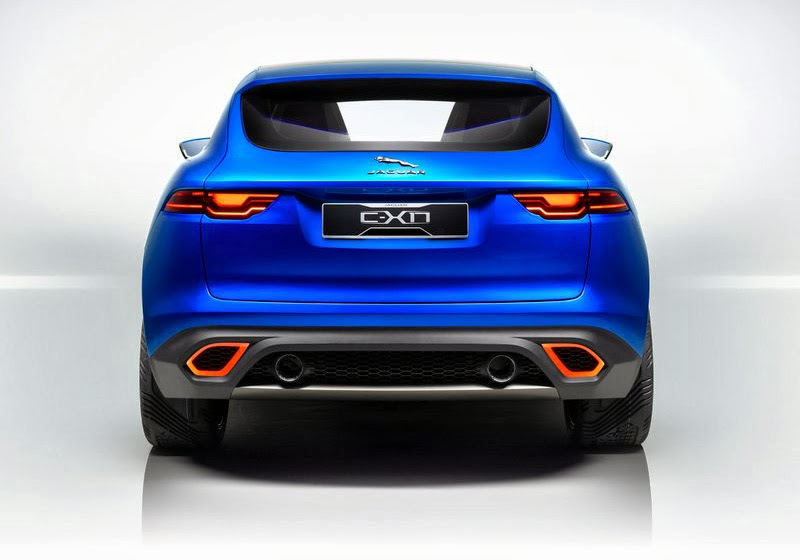
Jaguar C-X17 Concept, 2013


The Jaguar C-X17 concept illustrates the diversity of vehicles that could be produced using the architecture. A four-seater sports crossover concept built on the aluminium-intensive architecture, it blends sleek lines, sporting design and luxurious sophistication with enhanced flexibility and an assured driving position. In its exciting proportions, purity of form and its beautiful lines - overseen by Director of Design Ian Callum - the C-X17 is every inch a Jaguar.
The Jaguar C-X17 has been created as a design study to introduce Jaguar's all-new advanced aluminium monocoque architecture, codenamed iQ[Al], on which an exciting range of future Jaguars will be built. This new philosophy underpins the entire innovative future of the Jaguar brand. A modular and scalable vehicle architecture, engineered and developed for Jaguar, the architecture is high-strength, lightweight, extremely stiff and incorporates innovative efficiency technologies. It enables flexible high-volume production while allowing creative design freedom and competitive interior packaging, without compromising the unique character, dynamics, performance and luxury that Jaguar is famous for. This will enable Jaguar to grow its product portfolio, targeting high-growth areas of the premium market.

Jaguar's first ever sports crossover concept vehicle - the Jaguar C-X17 - made its debut at the 2013 Frankfurt Motor Show.

As a sports crossover, the Jaguar C-X17 stretches the design possibilities of the segment by combining the character and driving experience of a sports car with increased presence, style and flexibility. The sports crossover concept represents the potential expansion of Jaguar's portfolio of body styles, with the associated enhancement of the brand's relevance and appeal to a wider global audience.

Jaguar's first product from the new iQ[Al] architecture will be a new premium C/D segment sedan. Its global rollout will begin in 2015, and it the first aluminium monocoque product in the segment.

Power provided by engines with a wide range of capacities and output, all delivering inspirational performance and offering the latest innovations in fuel-efficient technologies without sacrificing drivability. These will include the high-output petrol and diesel engines to be built at Jaguar Land Rover's new engine manufacturing facility in the UK, as well as the powerful V6 petrol engine in the F-Type, which will provide best-in-class specific power output thanks to the lightweight architecture. These attributes will enable Jaguar to offer a wider variety of vehicles, with exhilarating performance, top speeds of over 300km/h (186mph), as well as emissions below 100g of CO2 per kilometre.

The Jaguar C-X17 could offer refined on-road dynamics and sedan car-like handling, thanks to its low height, optimised centre of gravity, and use of cutting-edge dynamic technologies such as Torque Vectoring by Braking, in which the car intelligently uses its brake system to balance the distribution of engine torque to the wheels during cornering, reducing understeer and maximising grip.

At 4,718mm long and 1,649mm tall, its dimensions are clearly that of a crossover, yet in its design it shares strong family traits with Jaguar's current range. For instance, the grille is an evolution of the distinctive nose of the Jaguar XJ luxury sedan, while the sculptured haunch lines hint strongly of the award-winning design of the Jaguar F-Type sports car. A low-sitting stance and overall profile combine with 23-inch alloy wheels to give the C-X17 a sporting, aggressive presence, while the LED headlamps, J-shaped running lights and frosted-glass foglights set into the large front intakes add to the C-X17's purposeful intent. The C-X17 is painted in a lustrous Caesium Blue finish, with gloss black brightwork surrounding the windows, while the split five-spoke alloys are Dark Atlas graphite with gloss black finishers.

The interior of the Jaguar C-X17 features four individual bucket seats, which are luxuriously appointed, yet designed for a sculpted, lightweight appearance. The car's unique roof features contoured vanes that provide a distinctive 'elliptical' panoramic view to the C-X17's passengers, while retaining the roof's sleek appearance from the exterior. Two additional rear-mounted leisure seats incorporated in the boot floor swing out for recreational use. Accessories that support an active lifestyle, such as a torch and a camera, are positioned in storage compartments in the boot.

The interior of the C-X17 marries premium, authentic materials and traditional craftsmanship with modern finishing techniques. It features a combination of Jet saddle Connolly leather and Orchid Connolly leather on the instrument panel, seats, armrests, doors, floor and in the boot, with stitching on the saddle leather creating a tactile feel. A subtle layered effect is created through the use of die-cut Houndstooth-pattern leather patches on the main leather panels. Ruthenium, milled aluminium and black brushed anodised metal finishes impart a darker tonal effect to the C-X17's interior. The door finish is gloss black.

A centre tunnel running the length of the car, from the instrument panel through to the rear passenger seats, incorporates the Interactive Surface Console - an interactive multi-passenger infotainment hub with a series of touchscreens under a continuous panel of transparent acrylic glass, which in conjunction with the secure in-car wi-fi network, enables the vehicle's passengers to connect and share experiences with each other and the outside world via social media. The C-X17's premium in-car digital audio system has been specially designed for the vehicle by British specialist audio firm Meridian, and the car's centre console is configured for a Head Up Display projector.

ALL-NEW ALUMINIUM ARCHITECTURE: UNDERPINNING THE FUTURE
iQ[Al] is not just a vehicle architecture, it is a completely new philosophy that underpins the innovative future of the Jaguar brand, enabling Jaguar to significantly grow its product portfolio, targeting high-growth areas of the premium market in global markets.

The first Jaguar to be delivered from the new architecture will be a new C/D segment premium sedan, which rolled-out globally from 2015. The first aluminium monocoque product in its segment, the new sedan will be produced at an all-new, ultra high-tech production facility in Solihull, creating new jobs and substantial opportunities for the supplier base.

The aluminium-intensive architecture be modular and scalable, providing a high degree of flexibility and making it possible to produce a wider bandwidth of models and derivatives than ever before. It is lightweight, extremely stiff and incorporates innovative technologies that emphasises Jaguar's commitment to sustainability, such as a new high-strength alloy made from almost 100% recycled raw material.

The architecture is being carefully developed to fully incorporate all the vehicle attributes established by Jaguar engineers. All products perform like true Jaguars, the flexibility and scope of the architecture guaranteeing the individual character of each one. Jaguar design and engineering teams collaborated closely on its development from the outset to ensure versatility of design combined with fully competitive interior packaging.

Powertrains
Future Jaguars will be powered by engines with a wide range of capacities and outputs, all delivering inspirational performance and offering the latest innovations in fuel-efficient technologies, without sacrificing drivability or feel. The new sedan will be the first vehicle to be equipped with all-new four-cylinder diesel and petrol engines, allowing Jaguar to break the 100g CO2/km barrier for the first time. These advanced, high-output engines will be built at Jaguar Land Rover's new engine production facility, currently under construction in Wolverhampton in the UK as part of a £500 million investment, which will be operational from 2015.

These vehicles are also designed to be powered by the powerful V6 petrol engine seen in the Jaguar F-Type sports car, which, combined with the lightweight architecture, will bestow them with best-in-class specific power output as in the F-Type. Together, the family of engines will offer the best of both worlds and deliver all-encompassing capabilities: sporting performance and class-leading fuel efficiency and CO2 emissions.

C-X17 DYNAMICS: FLEET-FOOTED AND SURE-FOOTED
As a sports crossover, the Jaguar C-X17 concept is positioned as a driver's car. It has an on-road bias, and its low height, optimised centre of gravity and lightweight all-aluminium body endow it with superior, car-like driving dynamics and a level of agility that would make it quite at home on the fastest roads. The C-X17 also features cutting-edge dynamic technologies such as Torque Vectoring by Braking, a system which constantly monitors the vehicle's cornering dynamics and, when required, intelligently uses the brake system to rebalance the distribution of engine torque to the wheels, in order to reduce understeer and maximise grip.

With its 213mm ground clearance and intelligent All-Wheel Drive, the C-X17 could also offer reassuring capability and enhanced grip on poor roads and in varying weather conditions. Jaguar's intelligent All-Wheel Drive system continuously monitors grip levels and driver inputs and uses feed-forward torque distribution to both pre-empt and react to wheel-slip, providing greater driver confidence and vehicle stability in low-grip conditions. In normal grip conditions, the system predominantly delivers drive to the rear wheels, providing the dynamic driving experience all Jaguars are renowned for.

EXTERIOR DESIGN: BEAUTY OF PROPORTION
With a crossover being a new journey for Jaguar, Director of Design Ian Callum and his team were clear that the C-X17 would not compromise on the time-honoured values of Jaguar car design: purity of form, beauty of line and balance of proportion. Even as it subscribed to the practicalities expected of the crossover category, the C-X17 had to be stylish, sporty and exciting. It had to instantly stand out from the crowd, yet retain the sense of timeless sophistication that is typically Jaguar.

The Jaguar C-X17 has dynamic yet perfectly balanced proportions, with the low profile and large wheels giving it a powerful, planted stance. In terms of form, it is sleek and fast, relying on pure lines rather than exaggeration or showmanship. The long bonnet's twin 'power bulges' and prominent grille impart a muscular look. The headlamps hint at the C-X17's sedan siblings while the grille is inspired by the XJ, resulting in a distinctive family look that is reassuringly familiar yet uniquely appealing. The grille features a hexagonal pattern, with small aluminium panels within its structure that can close to enhance the vehicle's aerodynamic properties.

The C-X17's twin 'heartlines' are clearly visible when viewed in profile. Two clean and simple design lines, with a subtle crease in the metal to catch the light, visually tie together the C-X17's shoulder and haunch. The accentuated length of the windows adds to the vehicle's overall sense of sleekness.

The rear of the vehicle has a distinctive touch of sports car about it, with the haunch, taillights and detailing all bringing to mind the seductive Jaguar F-Type. The C-X17's roofline swoops quickly rearwards, culminating in a distinctive cantilevered spoiler over a steeply raked rear window that enhances the crossover's sporting, 'fast-even-at-standstill' appearance.

The exterior paint finish is a lustrous Caesium Blue, and the window liners are gloss black, with the only brightwork on the vehicle being the badging at each end, lending the car a darker, sportier look. The large 23-inch wheels, which enhance the C-X17's solid stance, are a one-off design with five split spokes. They have a Dark Atlas graphite grey finish with gloss black finishers on the spokes.
INTERIOR DESIGN: CRAFTSMANSHIP AND TECHNOLOGY
The interior of the C-X17 blends high-end interactive technology with premium, traditionally crafted materials, resulting in a spacious, airy, luxurious and sophisticated cabin.

The Jaguar C-X17 seats four passengers in individual bucket seats. The seating position is relatively low for a crossover, giving the occupants a feeling of sitting deep within the cabin. The seats are lightweight units with a sculpted free-standing appearance, visually enhancing the airiness of the cabin.

The spacious boot incorporates two leisure seats that swing up and out of the boot floor for use when the car is stopped and the rear hatch opened. Solidly constructed from milled aluminium and finished in Connolly saddle leather, these seats swing outwards on a beautifully engineered hinge to provide a practical seating area when the car is stationary. Accessories that support an active lifestyle, such as a torch and a camera, are positioned in leather holsters, in storage compartments located in the boot.

Panoramic sculpted roof
The sense of openness inside the cabin is heightened by the C-X17's unique panoramic roof. The designers of the C-X17 have constructed the interior of the roof from a series of sculpted vanes running from front to rear, closely arranged in parallel and integrated into the header and cant rails. They are contoured on the lower side to generate extra headroom, and shaped to create a ring of space that enables a whole-roof view of the sky above, giving the occupants a sense of openness. The topside of the vanes follows the smooth profile of the glass roof, maintaining the sleek exterior lines of the C-X17.

Premium two-tone leather trim
The interior of the Jaguar C-X17 is a juxtaposition of premium traditional materials and modern finishing techniques. Designers drew inspiration from a variety of sources, from extruded aluminium lampshades and lattice-framed stools to premium leather shoes, jackets and handbags, which favoured strong colour contrasts.

Accordingly, the seats, instrument panel, floors, doors and boot are finished in an overlapping combination of Jet saddle leather and Orchid leather panels. Renowned British leather specialist Connolly, the benchmark name in premium automotive cabin craftsmanship, created the bespoke leather panels specially for the C-X17. The 3mm-thick saddle leather, which features bands of stitching to increase the passenger's tactile experience of these surfaces, is die-cut in a Houndstooth pattern inspired by traditional tailoring materials, lending the interior of the car a classy yet contemporary feel.

The interior door finish is gloss black, while for the interior metal finishes, ruthenium (a member of the platinum family) is used instead of brightwork, creating a darker, more tonal effect that suits the subtle, premium feel of the cabin.

Multi-passenger interactivity
The Jaguar C-X17 takes interactivity to a new level with the unique Interactive Surface Console that runs the length of the car's centre tunnel, from the centre console of the dashboard through to the rear seats. Made up of a series of interconnecting touch screens encased in transparent acrylic glass, the Interactive Surface Console connects those in the rear cabin with the driver and front seat passengers via a secure in-car Wi-Fi network.

The Interactive Surface Console allows the vehicle occupants to upload pictures, video and sound files from their mobile devices and share them with their fellow passengers, as well as on Facebook, Twitter, Instagram and other social media channels. Using the touchscreens and an intuitive user interface, information can be 'flicked' forwards and rearwards between the front and the rear passengers. By enabling sharing, both in terms of technology and information, between the occupants of the C-X17, the Interactive Surface Console puts as much focus on the rear compartment as on the front and immerses all four passengers in a unified multi sensory experience.

The C-X17 features a 12-loudspeaker system specifically developed for the vehicle by British ultra-premium audio experts Meridian. Designed closely in conjunction with the development of the C-X17's interior, the system draws on Meridian's award-winning digital sound processing technology. Trifield technology creates an all-enveloping sound field that makes each listener feel that the music is exclusively focused on him or her. With sub-woofer drive units in the rear centre tunnel, dashboard-mounted tweeters, speakers in the A and B pillars, twin door speakers, rear speakers, and head-height speakers situated in the tops of the front seat head rests, this unique system enables every occupant of the C-X17 to enjoy optimum, authentic sound for an exceptional in-car audio experience.

The Jaguar C-X17's instrument panel has a twin-dial configurable TFT console with provision for a Head Up Display - a system which projects vital information onto the windscreen for the driver to process quickly, akin to the systems used in modern fighter aircraft.

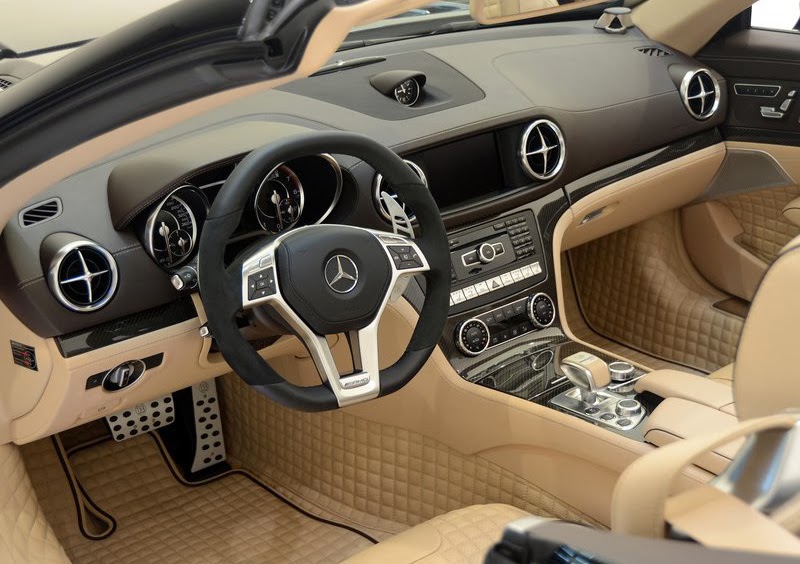
Brabus 800 Roadster, 2013


The Brabus 800 Roadster - supported the Mercedes SL65 AMG - Brabus builds the world's most powerful roadster. The motorcar is power-driven by a 12-cylinder Biturbo engine uprated by Brabus T65 RS standardization. It produces 588 power unit / 800 HP (788 bhp) of power and a peak torsion of one,420 Nm. A sprint time of three.7 seconds from rest to a hundred km/h (62 mph) and of nine.8 seconds to two hundred km/h (124 mph) area unit spectacular testaments to the car's special standing that's any bolstered by associate degree electronically restricted prime speed of 350 km/h (217 mph). The exclusive instrumentality options additionally embody Brabus carbon-fiber bodywork elements designed for max mechanics potency, custom-tailored Brabus wheels with diameters up to twenty inches and exclusive choices for the cockpit.

Brabus T65 RS standardization unleashes the latent power reserves of the six-liter V12 engine. to the current finish, the Brabus engine professionals have developed a Brabus sophisticated Biturbo system with custom superior manifolds that feature integrated rotary engine housings and superior turbochargers. The standardization additionally includes four water-to-air intercoolers, housed in area provided by the Brabus carbon-fiber hood scoop. Another custom development for the SL65 power upgrade is that the special Brabus stainless-steel superior exhaust. It options free-flow metal catalysts and ceramic-coated tailpipes with distinctive Brabus style. associate degree integrated valve within the exhaust provides a lively sound management on the steering wheel: at the push of a button the motive force will selected between a separate "coming home" and a markedly jazzy exhaust note.

The fresh mark engine natural philosophy complete with superior mapping for injection and ignition coordinate the proper interaction of the high-end elements whereas additionally making certain compliance with monetary unit V emission standards. The sophisticated lubricants for the complete powertrain area unit provided by technology partner Motul.

The Brabus T65 RS engine produces five88 power unit / 800 HP (788 bhp) of power at 5,500 rev and an excellent a lot of spectacular peak torsion of one,420 Nm (1,047 lb-ft), accessible from a coffee a pair of,100 rpm. In the car, peak torsion is proscribed electronically to one,100 Nm (811 lb-ft).

In conjunction with the AMG SPEEDSHIFT and 7G-TRONIC transmission, whose gears will be shifted mechanically or manually with the Brabus aluminium shift paddles on the wheel, the Brabus 800 Roadster rises to the become the foremost powerful of its kind. From rest the sports automotive deliberation in at concerning 2 metric tons (2.2 tons) sprints to a hundred km/h (62 mph) in precisely three.7 seconds. The two-door automotive reaches a speed of two hundred km/h (124 mph) when simply nine.8 seconds. prime speed is proscribed electronically to 350 km/h (217 mph).

To master these monumental speeds the least bit times, a Brabus aerodynamic-enhancement kit for the foreign terrorist organization sixty five was developed within the construction. All elements area unit factory-made from carbon fibers and area unit accessible either with a matt or high-gloss surface end. It goes while not saying; they'll even be painted within the car's exterior color.

The Brabus front spoiler attaches to the lower section of the bumper. It lends the roadster a a lot of jazzy look and reduces elevate on the front shaft. Brabus covers for the facet air vents spherical out the putting front for the SL65 AMG.

The 19-inch stock tires of the foreign terrorist organization sixty five, the Brabus suspension engineers have developed associate degree exclusive 20-inch sophisticated variant. The new Brabus Monoblock R "Platinum Edition" solid wheel offers the proper interdependency of light-weight construction and most strength due to progressive producing technology. additionally to the innovative construction, this wheel style additionally offers distinctive appearance with 10 double spokes organized in 2 matt metal and absolutely polished planes. The front shaft is fitted with wheels in size 9Jx20 shod with size 255/30 zirconium twenty tires. within the rear, tires in size 305/25 zirconium twenty mounted on size ten.5Jx20 wheels transfer the Brabus 800 Roadster's power of 800 horses to the asphalt. Brabus recommends superior tires from Continental, Pirelli and metropolis.

To give the motorcar even a lot of agile handling, Brabus developed a special management module for the rudiment suspension of the SL65 AMG. It lowers the ride height by concerning twenty five millimeters (1.0 inches).

The Brabus limited-slip rear differential with a protection rate of forty p.c will enhance handling performance any still.

Brabus adds even a lot of luxury and custom options to the two-seat interior upon request yet. the merchandise portfolio ranges from scuff plates with backlit Brabus brand and a meter with 360-km/h dial (220 mph) to carbon-fiber and wood trim sets in any color possible and with a spread of surface finishes.

Buick Riviera Concept, 2013

Buick Riviera Concept, 2013Buick Riviera Concept, 2013
 Buick Riviera Concept, 2013Buick Riviera Concept, 2013
 Buick Riviera Concept, 2013Buick Riviera Concept, 2013
  
The coupe combines avant-garde aesthetics and advanced technology, including plug-in hybrid electric vehicle propulsion, in a single package. It is the fourth global concept vehicle jointly developed by GM's Shanghai GM and Pan Asia Technical Automotive Center (PATAC) joint ventures in Shanghai.

Elegant Design Inspired by the Dynamic Nature of Water
The new Riviera's designers took inspiration from the Chinese saying: "The greatest good is like water." The vehicle's sweeping design, which goes from thick to thin, has the vibrant nature of a moving river embodied in its athletic shape, elegant ambience and deeply sculpted lines.

The concept's silhouette with Buick's recognizable "sweep spear" has a three-dimensional effect that resembles waves in the ocean coming to a standstill for a split second. Buick's unique gull-wing doors exude a dynamic yet elegant ambience. The new Riviera has an ice celadon finish inspired by jade.

Up front, the concept vehicle's updated waterfall grille and wing-shaped daytime running lights will both become key elements of Buick's future design DNA.

The new Riviera has a low drag coefficient and a harmonious balance between style and performance thanks to its raked windshield, 14-degree fastback design and metallic fiber spoiler, which are complemented by active grille shutters and diffusers, and active pneumatic wheels.

The interior carries on Buick's signature 360-degree integrated design with high levels of elegance and refinement. The eaglewood tone interior features the abundant use of refined materials such as sand-blasted aluminum alloy, lava suede and ebony used in a bold style reminiscent of traditional Chinese jade-inlaid wood. This creates a striking visual effect as well as a subdued sense of luxury.

The new Riviera's compact yet well-structured center console, front floating seats and adaptive seating system, as well as its noise-absorbing head restraint system, represent the best combination of interior design and elegance.

Innovative Propulsion, Infotainment and Safety Technology
The new Riviera has adopted BIP (Buick Intelligent Performance) technology. It is equipped with GM's all-new, dual-mode W-PHEV (wireless plug-in hybrid electric vehicle) propulsion system. The user can drive the car on green power in electric mode and enjoy the exhilarating handling and performance of a sports car while driving "green" in hybrid mode. In addition, the vehicle can be charged with a traditional cable or wirelessly via a sensory recharge panel on the car's chassis. The charging port is integrated into Buick's iconic porthole design.

The new Riviera is also equipped with intelligent four-wheel steering, an electromagnetic-controlled suspension and an air spring package for sure handling and comfort in extreme conditions.

The innovative mobile Internet system adopted in the new Riviera supports high-speed 4G LTE network use. The concept vehicle offers real-time traffic information, weather updates, and news and entertainment while communicating with other vehicles. The vehicle's voice commands and controls along with touch and gesture recognition activate a range of vehicle systems and enable seamless interaction between driver and vehicle.

The new Riviera employs a forward-looking active safety system that collects traffic information through 10 high-resolution cameras (for image monitoring) and 18 micro high-precision sensors (for distance monitoring). The information is integrated and presented in a holographic image onto the windshield.

The intelligent driver assist system provides occupants a high level of active safety and security. The system incorporates a variety of driver assist functions, including: an eagle view record system, night view assist, side blind-zone alert system, lane departure warning system, full-speed range-adaptive cruise control system, lane change assist system, parking assist system, rear cross-traffic alert system, autopilot system and "transparent" A pillars.

Buick Enclave, 2013

Buick Enclave, 2013, Luxury AutomobilesBuick Enclave, 2013, Luxury Automobiles
 Buick Enclave, 2013, Luxury AutomobilesBuick Enclave, 2013, Luxury Automobiles
 Buick Enclave, 2013, Luxury Automobiles

The Buick introduced the new 2013 Enclave, an evolution of the industry's best-selling three-row luxury crossover. It offers new styling, new safety technologies, in-vehicle connectivity and a more refined driving experience.

The LED daytime running lamps and LED tail lamps complement a more sculpted exterior design. The interior is more contemporary, with ambient lighting and Intelli Link in-vehicle communications with touch-screen control and navigation. The industry's first front center air bag system and new dual-flow front struts highlight the safety and performance enhancements.

The Enclave is offered in front-wheel-drive and all-wheel-drive models, and powered by a direct-injected 3.6L V-6 and an updated six-speed automatic transmission that contribute to the more refined driving experience. Buick's Quiet Tuning engineering process reduces, blocks and absorbs unwanted noise from the Enclave's cabin, making it quieter than a Lexus RX350.

Buick Enclave's sculpted styling redefined Buick's design language upon its introduction more than five years ago. The 2013 model adds new signature cues:
  • New front fascia with LED daytime running lamps
  • New headlamp design, with standard Xenon high-intensity discharge lamps (HID) and LED accent lighting. Articulating headlamps are available
  • New hood and black-chrome waterfall grille
  • New rear fascia design with integrated exhaust outlets
  • New LED tail lamps
  • New 19-inch and 20-inch aluminum wheel designs
  • Monochromatic exterior appearance with chrome accents.

The Buick Enclave's new appearance is instantly recognizable as a modern Buick and the LED lighting elements enhance its technologically advanced presence. The blue translucent rings around the Xenon HID headlamps are Buick design cues found on other models, adding distinction across the brand's lineup.

At the rear, the exhaust outlets are framed with a chrome finish within the rear fascia, for an integrated appearance that exemplifies Buick's attention to detail. New LED taillamps provide a safety benefit by illuminating more quickly than conventional bulbs when the brakes are applied.

Harmonious interior environment
The 2013 Enclave's interior is defined by luxurious amenities and high-quality materials, with changes that create a more contemporary ambience and support the integration of Buick IntelliLink.

Highlights:
  •     New ice blue LED ambient lighting around the dash highlights Enclave's flowing lines, emphasizing the cabin's spaciousness
  •     Eight-way power front driver and passenger seats with four-way adjustable head restraints emphasize seat comfort
  •     Details including soft touch materials and live stitching throughout the cabin, as well as true chrome accents
  •     Four interior color combinations are available with complementing wood tones, including a new Cocoa leather combination
  •     A new "center stack" with standard IntelliLink LCD display, tri-zone climate system, capacitive touch controls and available navigation system.

The new center stack was developed for easy, intuitive interaction with the new IntelliLink system, along with redundant controls on the genuine Mahogany-accented steering wheel. The tri-zone climate system's new controls are designed to be more intuitive, too, with easier, at-a-glance operation, bold digital temperature readouts and larger controls that are easier to operate with gloves.

Buick Enclave offers three rows of seating, available in seven- or eight-passenger configurations. The second-row seats feature the SmartSlide system, which allows easier entry to the third row, with the pull of a single handle. There is 23.3 cubic feet (660 liters) of cargo space behind the third row and a maximum of 115.2 cubic feet (3,263 liters) of cargo space available when the second and third rows are folded. That's more than the Mercedes-Benz R Class, Infiniti JX, Acura MDX, Lincoln MKT, Audi Q7 and the Volvo XC90.

Friday, January 9, 2015

Alfa Romeo Gloria Concept, 2013

Alfa Romeo Gloria Concept, 2013, Autos, Luxury Automobiles, Automotive, Car Concept

The European Design Institute (IED) of Turin is presenting the world première of 'Gloria', the concept by the Master in Transportation Design in collaboration with the Alfa Romeo Style Centre. The prototype represents the sports spirit and Italian style of a brand with powerful international appeal, whose products have brought the beauty of Italian design into the wider world. It was 1966 when the Spider Duetto in the film The Graduate reinforced the mythical image of the car manufacturer in the United States. Today, the Alfa Romeo Gloria Concept is intended as another international challenge, again looking overseas, to the American and Asian markets.

The European Design Institute of Turin, thanks to the support of and vicinity to the Fiat-Chrysler EMEA Design Center, has had the opportunity of 'training' its young car designers on the subject of: "conceiving an Alfa Romeo saloon to communicate to the American and Asian markets". In effect, the saloon remains a symbol of elegance and prestige for these markets, associated with the idea of comfortable space both at the front and the rear, expressed by the length of the model. In particular, the Alfa Romeo Style Centre participated with passion in the various phases of the project: from the product brief to the brand's historic collection, and from the first style proposals up to the development, in clay, of the model in 1:1 scale.

4700 mm long, 1920 mm wide, 1320 mm high and with a wheelbase of 2900 mm, Alfa Romeo Gloria Concept is a sports saloon with decisive lines that run down the side to the rear end. It would be propelled by a state-of-the-art V6 or V8 biturbo engine on the road. The bonnet powerfully evokes the Alfa Romeo shield through the lines of the car, which highlight the three-dimensional aspects of its form. The leather strips at the front recall the memorable leather straps for the luggage compartments of the brand's historic cars.

Alfa Romeo Gloria Concept springs from the work of twenty students on the Master programme (2011/2012 academic year) from both Italy and other countries and cultures. The concept is the result of a process that simulated a real work situation: from the brief of the Alfa Romeo Style Centre and the style research up to the twenty design proposals developed in 1:4-scale clay models. From all the models, the one that corresponded most closely to the initial brief provided by Alfa Romeo was chosen. The entire class of students, divided into groups but highly involved and motivated, then worked on the final project in full scale.

Thursday, January 8, 2015

Subaru BRZ, 2013


Subaru BRZ is a rear-wheel drive sports car featuring the Horizontally-Opposed Boxer engine. It was developed as a joint-project between Subaru and Toyota Motor Corporation, to bring to the world a sports car with superior steering response and driving pleasure that everyone can experience. The Subaru Boxer engine in the BRZ was positioned even lower than other Subaru models so that the BRZ has one of the lowest possible centers of gravity s on the market today. This low center of gravity produces astonishing handling character and combined with a light-weight chassis BRZ realizes Subaru's aim for "Pure Handling Delight" - the driving experience taken to a new level.

Concept
The product concept of Subaru BRZ is "Pure Handling Delight." The Horizontally-Opposed Boxer engine has inherent qualities of low center of gravity, lightweight, and compactness. These attributes are maximized by placing this engine even lower and closer to the center of the chassis. These factors contributed to BRZ's low center of gravity - one of the lowest possible. The Subaru BRZ is a fun sports car that any driver can enjoy driving with peace of mind.

Design
The Subaru BRZ has a low-mounted Boxer engine on a specially designed sub-frame that forms an "ultra-low center of gravity package". With this arrangement, BRZ achieved a low driving position typical of a sports car. Overall height of Subaru BRZ is 1,300 mm and it has a wide and low body of a stylish coupe at 1775mm. Yet, it allows for 2+2 seating and a trunk with ample space. Not only is the BRZ a sports car, but it can also be a suitable partner for long tours with its unexpected utility.

Exterior
Subaru aimed for a sports car design that instinctively conveys the car's fun-to-drive character. In addition, it was detailed to be instantly recognizable as a Subaru.

Front fascia
The "ultra-low center of gravity package" also allowed a low hood design. This low hood and bulging front fenders raise expectations for the Subaru BRZ's drivability. Also, to communicate the Subaru identity the Subaru six-star ornament, headlights and hexagon lower grille follow the Subaru design motif common across new Subaru models.

Side
The low center of gravity enhances BRZ's sensuous beauty with its shapely fender flares. The aesthetic beauty is combined with functional beauty that advances aerodynamics through such areas as the C-pillar shape, rear glass inclination, trunk lid layout. As would be expected from a sports car, the front and rear overhangs were shortened to express the Subaru BRZ's liveliness. The front fender is accentuated with a distinctive garnish.

Rear fascia
The projecting rear wheel arches sit by way of contrast to the compact cabin and emphasizes the beauty of the BRZ's rear view.

Interior
Details were carefully designed to allow a new level of fun-to-drive experience in which the driver and vehicle become one.

The steering wheel was made smaller to achieve sports car maneuverability.

A tachometer with digitally displayed speedometer is placed in the center of the gauges so that the driver can instantly see information without diverting attention from the road.

Bespoke sports car seats were designed to hold the driver and passenger and feature lowered sitting positions to match the "ultra-low center of gravity package".

Engine
Making full use of the design concept of the new-generation Boxer engine, the newly developed engine made exclusively for the BRZ is highly efficient with superior output and environmental friendliness. It realizes an exhilarating high revving nature of a naturally aspirated sports engine.

It has square bore and stroke of 86 x 86 mm.
Due to the joint development with Toyota Motor Corporation, Toyota's direct injection and port injection technology "D-4S" was incorporated in the Subaru BRZ's power unit.

To achieve the "ultra-low center of gravity package", the engine as a whole has been made more compact by such means as adopting the shorter intake manifold and the shallower oil pan.

Transmission
The joy of sports car driving was realized through a transmission that focuses on shift feel and response.

The 6-speed MT employs a short stroke shift lever. The lever was optimized in rigidity, shift quality and weight application in its pursuit of a superb shift feel.

The 6-speed AT has "S mode" for better shifting response and "M mode" for optional shifting. Also, with the paddle shift and downshifting blipping control, this model can respond faithfully to the driver's inputs.

Body
The lightweight yet highly-rigid body was developed exclusively to maximize the advantages of the "ultra-low center of gravity package".

Low center of gravity and low driving position were achieved by the perimeter type body frame layout.

The body has a rigid and durable frame structure that also works in balance with the vehicle's light-weight. The rigidity is optimized for high drivability and appropriate durability is maintained for collision safety.

High tensile steel was used in the body to contribute to weight reduction. Effective use of this material in the upper structure of the Subaru BRZ contributed to its low center of gravity.

The front hood employs aluminum for lightness. The structure was fine-tuned for a low styling that also improves pedestrian protection performance.

Chassis
Excellent maneuverability and stability of the "ultra-low center of gravity package" offers direct and sharp response to steering and enhances driver's connection to the car

The front suspension employs struts for light-weight and high rigidity, while a double wishbone layout is adopted at the rear for better shock absorption.

To gain a low front hood from the "ultra-low center of gravity package", the front strut mount was lowered while maintaining the stroke.

The tires are 215/45R17 combined with lightweight and highly rigid aluminum wheels.

All models are equipped with electronic stability control to provide both driving pleasure and safety.